
LH Surge vs Ovulation: What the LH Surge Actually Means for the Egg
For many people trying to conceive, the luteinising hormone (LH) surge is familiar because of ovulation predictor kits. You test your urine, the line becomes darker or a digital test displays a positive result, and ovulation is expected to follow. But the LH surge is more than a marker of the fertile window. Inside the ovarian follicle, the LH surge triggers a coordinated series of events that help prepare the oocyte (the egg) for ovulation and potential fertilisation.
During this time, the oocyte undergoes one of the most important developmental transitions of its life. It resumes the specialised cell division known as meiosis, progresses towards maturity and prepares to receive the genetic material carried by a sperm. Understanding this process helps explain an important distinction: An LH surge tells us that the biological process leading towards ovulation has been initiated. It does not confirm that ovulation has occurred.
So, what actually happens between the LH surge and the release of an egg?
What Is the LH Surge?
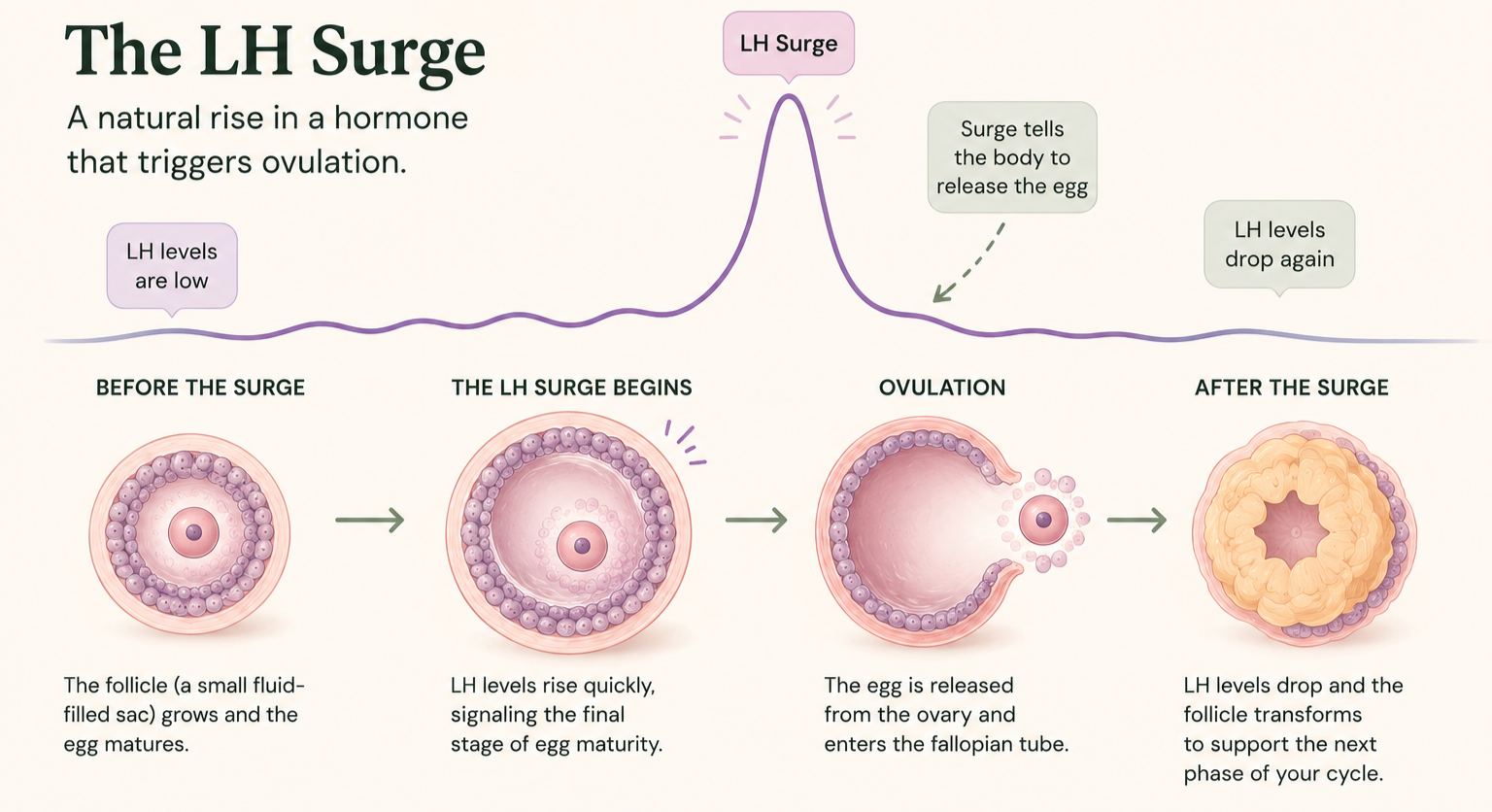
During the first half of the menstrual cycle, several ovarian follicles may begin developing under the influence of follicle-stimulating hormone (FSH). Usually, one follicle becomes dominant and continues to grow. As the dominant follicle develops, the cells surrounding the oocyte produce increasing amounts of oestradiol. When oestradiol remains sufficiently elevated, its effect on the brain and pituitary gland changes. Instead of suppressing the release of reproductive hormones, the high oestradiol concentration triggers a rapid increase in LH secretion. This is the LH surge.
The surge acts on the mature follicle and initiates several processes that are necessary for ovulation. These include changes within the follicle that contribute to follicular rupture, transformation of the follicular cells that will later form the corpus luteum, expansion of the cumulus cells surrounding the oocyte and, importantly, the resumption of meiosis within the oocyte itself.
In other words, the LH surge does not simply tell the ovary to release an egg. It begins the final maturation process that prepares the oocyte for ovulation and potential fertilisation.
What Happens to the Egg Before the LH Surge?
The term egg is often used to describe female reproductive cells at every stage of development. Biologically, however, the cell released during ovulation has undergone a long and highly regulated developmental process. Human oocytes begin forming before birth. For many years, they remain arrested at an early stage of meiosis known as prophase I. Within the growing ovarian follicle, the oocyte remains in this arrested state while the follicle develops around it.
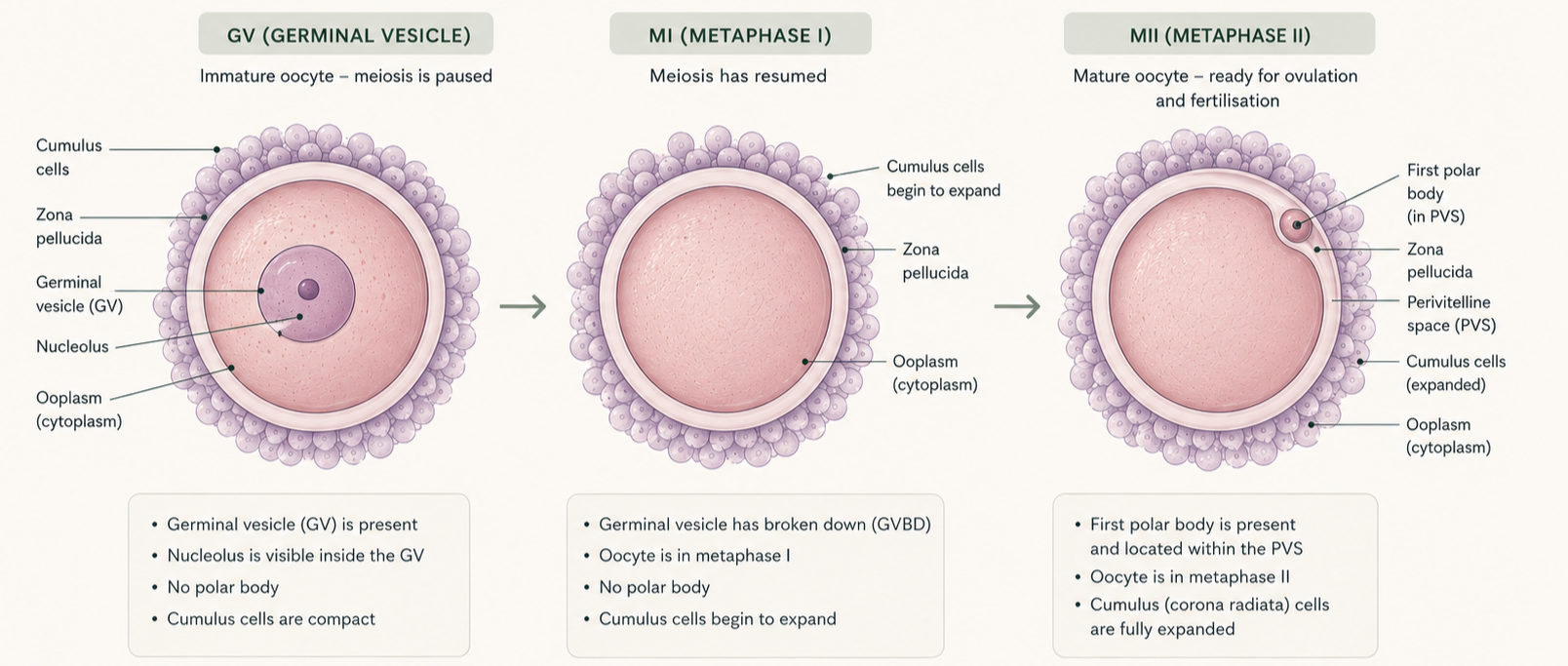
At this stage, the oocyte contains a visible nucleus called the germinal vesicle. In embryology laboratories, an oocyte at this stage of development is therefore commonly described as a GV oocyte. A GV oocyte is immature.
Before the oocyte can become capable of normal fertilisation, it must resume meiosis and progress through several developmental stages. The LH surge provides the physiological signal that begins this process.
What Happens to the Egg During the LH Surge?
Following the LH surge, communication between the oocyte and the surrounding cells of the follicle changes. These changes allow the oocyte to resume meiosis. The first visible sign of this process is the breakdown of the germinal vesicle, known as germinal vesicle breakdown (GVBD). The chromosomes within the oocyte then reorganise as the cell progresses through the first meiotic division. The oocyte enters metaphase I (MI).
At this stage, the oocyte is undergoing maturation but has not yet completed the first meiotic division. The chromosomes are then separated between the oocyte and a much smaller cell called the first polar body. Following extrusion of the first polar body, the oocyte progresses into the second meiotic division and reaches metaphase II (MII). It then pauses again.
The developmental sequence can be simplified as:
GV oocyte → germinal vesicle breakdown → MI oocyte → first polar body extrusion → MII oocyte
An MII oocyte is the mature stage normally capable of being fertilised. This entire process is known as oocyte maturation. Importantly, the oocyte has not completed meiosis at this point. It will remain arrested at metaphase II unless fertilisation occurs.
Why Does Oocyte Maturation Matter?
Successful fertilisation requires more than sperm reaching an oocyte. The oocyte must also be developmentally capable of responding to the sperm and completing the processes required for normal fertilisation. During maturation the oocyte must undergo coordinated genetic, molecular and metabolic changes to support fertilisation and early embryo development. This includes completing the first meiotic division to reduce its chromosome number, as well as accumulating and organising the cellular machinery and energy stores needed for fertilisation and the earliest stages of development. However, reaching MII does not guarantee that an oocyte will fertilise or develop into an embryo. Normal fertilisation depends on both the oocyte and sperm successfully completing several further biological processes.
Is the LH Surge the Same as Ovulation?
No - the LH surge and ovulation are related biological events, but they are not the same thing. The LH surge is a hormonal signal. Ovulation is the physical release of the oocyte from the ovarian follicle.
The LH surge initiates the processes that usually lead to ovulation, including oocyte maturation and changes within the follicle that contribute to follicular rupture. Ovulation occurs later. This distinction matters when using ovulation predictor kits.
A positive LH test indicates that urinary LH has risen above the detection threshold of the test. It therefore provides evidence that the hormonal process associated with approaching ovulation is occurring. It does not demonstrate that the follicle subsequently ruptured or that an oocyte was released. A positive ovulation test predicts that ovulation may be approaching. It does not confirm that ovulation has occurred.
How Long After the LH Surge Does Ovulation Occur?
You may have seen claims that ovulation always occurs a specific number of hours after a positive ovulation test. The biology is more variable. Studies investigating the timing of ovulation have found considerable variation in both the characteristics of the LH surge and the interval between the surge and follicular rupture. Part of the confusion comes from how the LH surge is measured.
Timing can be calculated from:
the onset of the LH surge,
the peak concentration of LH,
the first positive urinary LH test,
or the detection of follicular rupture on ultrasound.
These are not interchangeable measurements.
In general, ovulation commonly occurs within approximately 24–36 hours of the onset of the LH surge, although there is meaningful variation between individuals and between cycles. Urinary ovulation predictor kits (OPKs) add another layer of uncertainty because they detect LH after it has entered the urine and only become positive once LH exceeds the test’s detection threshold.
A positive OPK is therefore best understood as evidence that you are likely within your fertile window, rather than a precise countdown to the moment of ovulation.
Does a Positive LH Test Confirm Ovulation?
No - an LH surge demonstrates that the hormonal signal associated with approaching ovulation has occurred. It cannot tell us whether the follicle subsequently ruptured. This is why LH testing is primarily considered a method of predicting ovulation, rather than confirming it.
Other methods can provide retrospective evidence that ovulation has occurred. For a closer look at the signs that can help you determine whether ovulation has already happened, read our guide: 5 Signs of Ovulation: How to Know If You’re Ovulating.
Can You Have an LH Surge Without Ovulating?
Yes - the body can initiate the hormonal sequence associated with approaching ovulation without immediately completing the process. Sometimes the ovary makes another attempt later in the same cycle. This can result in more than one rise in LH or multiple positive ovulation tests. In other cycles, ovulation may not occur. This is known as an anovulatory cycle.
Repeated or prolonged elevations in LH can also occur in some people with polyendocrine metabolic ovarian syndrome (PMOS, previously known as PCOS), which can make urinary LH tests more difficult to interpret. An isolated positive LH test should therefore always be understood within the wider context of the menstrual cycle.
What Happens to the Egg After Ovulation?
If ovulation occurs, the mature MII oocyte is released from the follicle surrounded by a layer of specialised cells called the cumulus–oocyte complex. The oocyte is captured by the fallopian tube, where fertilisation may occur if viable sperm are present. But even at this stage, the oocyte has still not completed meiosis. It remains arrested at metaphase II.
If a sperm successfully interacts and fuses with the oocyte membrane, the sperm triggers a series of calcium oscillations within the oocyte. These signals activate the oocyte. The oocyte then completes the second meiotic division and extrudes the second polar body.
If a sperm successfully fuses with the oocyte, it triggers activation of the oocyte and allows it to complete the second meiotic division. What happens next involves another series of coordinated events as the genetic material from the oocyte and sperm is prepared for the first stages of embryo development.
What happens after fertilisation? Explore our visual guide to what normal fertilisation looks like and what embryologists assess during the fertilisation check.
What Does This Mean When You’re Trying to Conceive?
Ovulation predictor kits are useful because they provide information in advance. A positive test can help identify the days when intercourse or insemination is most likely to overlap with the fertile window. But the test cannot tell you:
whether the follicle actually ruptured,
whether a mature oocyte was released,
whether sperm reached the oocyte,
whether fertilisation occurred,
or whether an embryo subsequently developed.
This distinction can be particularly important when interpreting cycle tracking data. LH predicts, while post-ovulatory progesterone-related changes can provide evidence that ovulation occurred.
The Bottom Line
The LH surge is often discussed simply as a way to predict ovulation. Biologically, it represents something much more significant. The surge initiates a coordinated series of changes within the ovarian follicle that allow the oocyte to resume meiosis, progress towards maturity and prepare for ovulation and potential fertilisation.
The oocyte progresses from an immature GV stage, through meiosis I, extrudes the first polar body and reaches the mature MII stage normally capable of being fertilised. Only after fertilisation will the oocyte complete meiosis II.
A positive LH test can therefore provide useful evidence that ovulation may be approaching, but it cannot confirm that ovulation occurred, that a mature oocyte was released or that fertilisation took place.
Understanding the LH surge means understanding the biological transition between the developing ovarian follicle and the mature oocyte that may ultimately become an embryo.